A poll of about 2,700 individuals living in rural America discovered that 25 percent list opioid or other drug addiction as the "most serious problem" their community is handling. This comes in above economic concerns, which pulled in 21 percent.
"These findings suggest that in today's economically stretched rural United States, opioid or other drug addiction or abuse has emerged as an equal problem with economic concerns," study authors from the Harvard T.H. Chan School of Public Health and the Robert Wood Johnson Foundation said.
For a full breakdown of the results the study, published in JAMA Network Open, click here.

Showing posts with label Opioid Epidemic. Show all posts
Showing posts with label Opioid Epidemic. Show all posts
Unspoken Victims: At This Camp, Children of Opioid Addicts Learn to Cope and Laugh
Children are often called the hidden casualties of the opioid epidemic. They carry a lot of secrets and shame.
The majority of children at Camp Mariposa in Dayton, Ohio, have parents who are addicted to opioids. The nonprofit group Eluna runs camps in 13 states, many of them in areas hardest hit by the opioid crisis. All of these children have experienced trauma, sometimes abuse and neglect, and a growing number are in foster care. These children often struggle to reconcile the loving parents they remember with who they have become.
The majority of children at Camp Mariposa in Dayton, Ohio, have parents who are addicted to opioids. The nonprofit group Eluna runs camps in 13 states, many of them in areas hardest hit by the opioid crisis. All of these children have experienced trauma, sometimes abuse and neglect, and a growing number are in foster care. These children often struggle to reconcile the loving parents they remember with who they have become.
One of them is 8-year-old C.
Take a few minutes to learn their stories and hear their pain. To read this touching and heart-wrenching article, click here.
Those left behind: In the aftermath of an opioid death, families find ways to cope
Parents, family and friends come together to discuss their epic battle against opioid abuse after losing loved ones to addiction. They work to reduce the stigma and guilt associated with their trauma and do their best to prevent similar situations from occurring for other families.
From grief to acceptance to the impact of opioid overdoses on siblings, this thoughtfully written article covers the gamut. How do these families pick up their lives and move on after such a loss?
Click here to read the article published by the Daily Hampshire Gazette.
From grief to acceptance to the impact of opioid overdoses on siblings, this thoughtfully written article covers the gamut. How do these families pick up their lives and move on after such a loss?
Click here to read the article published by the Daily Hampshire Gazette.
Oklahoma's Opioid Case Against Johnson & Johnson Goes to Court
The case filed by Oklahoma against Johnson & Johnson over
its possible involvement in the opioid epidemic has begun. NBC calls it a
precedent-setting trial. The state’s attorney general has accused Johnson &
Johnson of misleading doctors for years by de-emphasizing the risks of opioids
and instead touting the benefits.
Johnson & Johnson disputes the allegations and is
fighting them in court. Oklahoma’s attorney general has accused other big pharma
companies with similar allegations. Some of those companies have settled prior
to going to trial. It appears that Johnson & Johnson will see the case
through in court.
See NBC's coverage below:
MN Senate Follows Closely Behind State House in Passing Opioid Legislation
The Minnesota State Senate followed two weeks behind the
state House in passing legislation that creates a new Opiate Epidemic Response
Account to fund initiatives locally and statewide to address addiction.
“The opioid epidemic has ravaged families across our state,”
said Sen. Rich Draheim (R-Madison Lake). “Nationally, it is now more likely to
die from an opioid overdose than a car accident. While this legislation is not
perfect, it preserves physician and pharmacist discretion while funding local
programs that directly impact families and individuals impacted by opioid
addiction.”
After passing the Senate, the bill now heads to a conference
committee with the House of Representatives where the bills will be resolved
into one proposal.
To read the full Minnesota Sentate Republican Caucus press
release, click here.
NJ Bill to Require Warnings Label on Rx Opioids Passes Senate
Legislation sponsored by Senator Kristin Corrado (R-40) in New Jersey requiring prescription opioid medications to include a warning
sticker advising patients of the risk of addiction and overdose has passed the
New Jersey Senate.
“New Jerseyans who are prescribed opioid
medications should be aware of the potential dangers every time they reach for
the bottle,” Corrado said. “The unprecedented rise in opioid deaths proves that
we must do more to combat the addiction crisis. The bill we passed today is a
simple step, but it will save countless lives.”
Corrado’s bipartisan bill, S-2244/A-3292,
would require any prescription opioid medication dispensed in the State of New
Jersey to include a warning sticker describing the risks of opioid medications.
Opioids that would qualify for a label under the bill include codeine,
hydrocodone (Vicodin), hydromorphone (Dilaudid), meperidine (Demerol) and
oxycodone (OxyContin).
7-day Prescription Bill Proposed to Mitigate Opioid Abuse

Sens. Kirsten Gillibrand, D-N.Y. and Cory Gardner, R-Colo. announced the introduction of the John S. McCain Opioid Addiction and Prevention Act
(S. 724), which would limit to a seven-day supply the initial
prescriptions of opioids for acute pain. This limit would mandate what the Centers for Disease control already recommend.
Did the FDA ignite the opioid epidemic?

A drug manufacturer denounces his own industry and explains to 60 Minutes how a label change by the FDA expanded the use of opioids. Bill Whitaker reports. Air Date: Feb 24, 2019 Watch the video.
Timeline of the Opioid Crisis

(Source: CNN)
The opioid epidemic has roots that date back to the 1800s when Heroin was believed to be less addictive than morphine. CNN created timeline of how the United States got to where it is today. Go to the Timeline
Real Solutions-How One Small Town in Minnesota Beat the Opioid Crisis
Town
halls and committees all over the country are looking for ways to
combat the opioid epidemic. Many are turning to the places that have
succeeded in making a noticeable difference in their community.
Little Falls, Minnesota, didn’t do anything revolutionary. They just made a real effort, and spent real money, treating addiction as a disease, not a crime.
Read more about what worked for them.
Little Falls, Minnesota, didn’t do anything revolutionary. They just made a real effort, and spent real money, treating addiction as a disease, not a crime.
Read more about what worked for them.
What is the US Opioid Epidemic?
- In the late 1990's, pharmaceutical companies reassured the medical community that patients would not become addicted to opioid pain relievers and healthcare providers began to prescribe them at greater rates.
- Increased prescription of opioid medications led to widespread misuse of both prescription and non-prescription opioids before it became clear that these medications could indeed be highly addictive.
- In 2017 HHS declared a public health emergency and announced a 5-Point Strategy To Combat the Opioid Crisis
- Visit the Department of Health and Human Services web page on the opiod epidemic for more information and statistics.
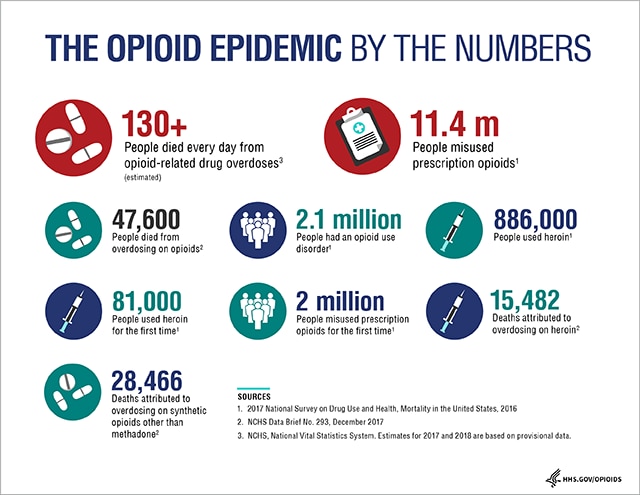
Download the Opioid Epidemic in the U.S. The Opioids By The Numbers” graphic and PDF are currently undergoing 508 review. Assistive technology users should email 508helpdesk@hhs.gov.
Controlled Substance Safety Labels: A Pharmacy Solution to Help Combat Opioid Addiction
More than half of patients lack confidence in their ability to properly
take new medications as directed, according to a new
survey. When patients answered how they would like to learn about new medications, written materials came in dead last.
“Rather than rely on written handouts from doctors and pharmacists, we
must take advantage of technologies like smartphones and patient portals to
deliver impactful, customized details about prescribed medications,” says
Cameron Deemer, president of the company that completed the survey.
Videos would be one avenue. Physicians and pharmacists are short on
time, so a safety video, especially when it comes to controlled substances,
could make a huge difference in adherence and patient safety.
New to the market is a pharmacy label option: Controlled Substance
Safety Label (CSSL). This auxiliary label distinguishes a Schedule II
medication, calling attention to the addictive nature and risk for overdose,
and reinforcing the need for caution when taking the drug.
 |
| Try it now: scan the QR code to play safety video |
A CSSL features a QR code which, when scanned, plays a brief safety
video, detailing a drug’s instructions, side effects and warnings in an easy-to-understand
audio and visual format.
Anyone, no matter their level of reading comprehension or sensory
input, would benefit from a CSSL label when prescribed a dangerous drug.
CSSLs are available across the US and Canada at participating
pharmacies by request.
Americans are now more likely to die from opioid overdoses than car crashes
The opioid epidemic is not a bigger public health and safety threat than car crashes. For the first time in history, Americans are more likely to die from opioid overdoses than car crashes, according to a new report from the National Safety Council.
Based on 2017 data, people in the US have a 1 in 103 chance of dying in a motor vehicle crash over their lifetime, but a 1 in 96 chance of dying of an opioid overdose.
Subscribe to:
Posts (Atom)